Skip to contentChina’s medical manufacturing sector is becoming an important source of precision polymer parts. Grand View Research estimates that the global medical plastics market reached about USD 38.4 billion in 2023. Its report also forecasts continued growth through 2030, driven by disposable devices, diagnostic equipment, and minimally invasive procedures. Demand is visible in small details: transparent syringe barrels, molded catheter hubs, ventilator connectors, and surgical instrument housings.
Quality matters more than volume. The World Health Organization emphasizes reliable medical devices, traceable production, and risk-based quality controls. In China, manufacturers must also address National Medical Products Administration requirements, alongside standards such as ISO 13485 and ISO 10993. These frameworks influence material selection, biocompatibility testing, sterilization validation, and production records. A polished surface alone proves little.
This guide examines China’s top 10 medical plastic components manufacturers through practical criteria. These include injection-molding accuracy, cleanroom capability, engineering support, resin control, tooling expertise, and documented validation experience. Suppliers serving global medical-device companies should demonstrate more than attractive catalog photographs. They should explain how they control flash, particulate contamination, dimensional drift, and batch traceability.
The comparison is not perfectly universal. Different devices require different strengths. One supplier may excel at high-volume disposable components, while another handles complex PEEK parts or tight-tolerance assemblies. Industry reports also use different market definitions, so their figures should be read carefully. The manufacturers below are therefore presented as informed candidates, not unquestionable winners. Medical plastic components deserve evidence, not assumptions.
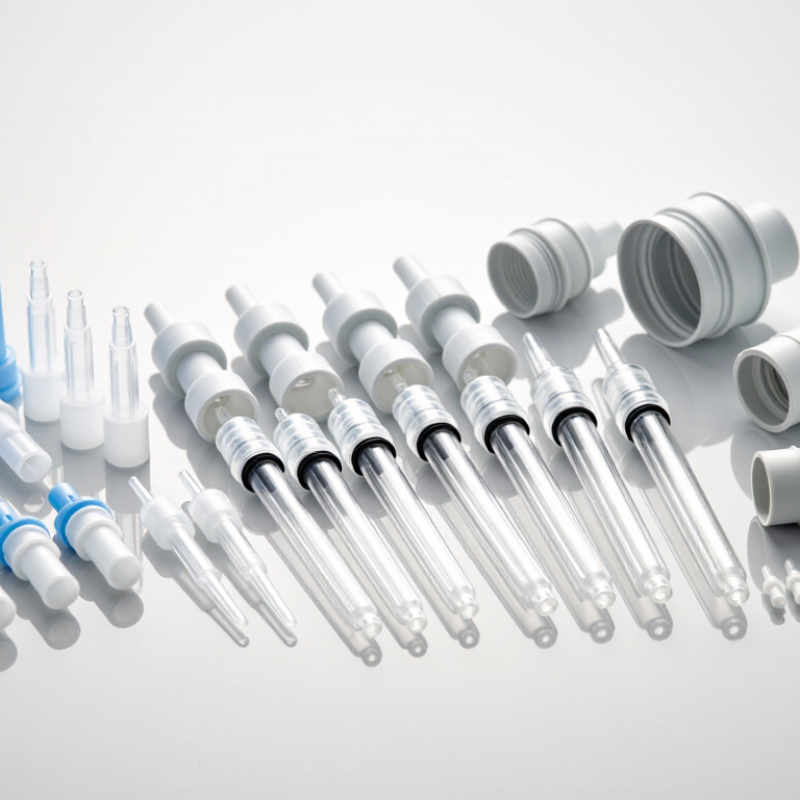
Medical plastic components are engineered parts used inside or around healthcare products. They include syringe barrels, catheter hubs, fluid connectors, valve bodies, device housings, surgical handles, and diagnostic cartridge chambers. Some are visible. Others guide fluids through channels thinner than a pencil lead. Their purpose is not decoration. Each part must fit, seal, withstand sterilization, and perform consistently.
Common materials include polypropylene, polycarbonate, polyethylene, and PEEK. Material selection depends on chemical resistance, stiffness, transparency, temperature exposure, and patient contact.
Grand View Research estimated the global medical plastics market at approximately USD 44 billion in 2023, with strong growth expected through 2030. The report connects this growth with disposable devices, diagnostic equipment, and minimally invasive procedures. Demand is expanding, but material choice remains highly application-specific.
Precision molding is only one step. Manufacturers also control resin traceability, mold cleanliness, dimensional inspection, and assembly conditions. ISO 13485 supports quality management for medical devices, while ISO 10993 helps evaluate biological safety.
OECD data showed global plastic production reached about 460 million tonnes in 2019. That figure is broad, not medical-specific, yet it highlights the scale of material responsibility. A small flash edge can damage a seal. A tiny particle can affect a fluid path. Compliance documents may look complete, but weak process control still needs honest review.
Medical plastic components are classified by material, function, and patient contact. Common families include thermoplastics, elastomers, and engineering polymers. Each behaves differently under heat, chemicals, pressure, and sterilization. A connector may need stiffness, while a seal needs controlled flexibility. Small differences matter.
MarketsandMarkets reported that the global medical plastics market could grow from about USD 26.5 billion in 2023 to USD 38.4 billion by 2028. This growth reflects demand for lightweight housings, fluid-handling parts, surgical tools, and diagnostic devices. Manufacturers in China often classify components by production method too. Injection-molded parts support high-volume precision. Extruded tubing supports continuous dimensions. Machined prototypes help verify designs before tooling investment.
Risk classification adds another layer. Components with direct blood or tissue contact require stronger biological evaluation than external covers. ISO 10993 guidance supports testing for cytotoxicity, sensitization, irritation, and other risks. ISO 13485 also emphasizes controlled processes and traceable quality records. Sterilization can change that picture. Gamma radiation may affect polymer strength, while steam can distort poorly selected materials.
The categories are useful, but not perfectly clean. A single valve may fit several groups at once. That creates practical confusion during sourcing. Material certificates alone cannot prove product safety. Process validation, dimensional inspection, and documented change control remain essential. Good classification should describe the component’s real use, not only its plastic name.
China’s medical plastic sector relies heavily on precision injection molding. Machines produce housings, fluid connectors, diagnostic trays, and surgical components. Grand View Research estimated the global medical plastics market at about USD 38.8 billion in 2022. That growth increases pressure on Chinese factories to control variation, not only production speed.
Cleanroom injection molding uses validated molds, medical-grade resins, and documented process settings. Operators monitor melt temperature, injection pressure, cooling time, and cavity balance. Multi-cavity tooling lowers unit cost, but it can amplify small defects. A single uneven gate may create flash across thousands of parts. That risk is easy to underestimate.
Extrusion forms tubing, catheters, and flexible profiles with continuous dimensional control. Blow molding creates hollow containers, while liquid silicone rubber molding supports soft seals and wearable components. CNC machining and ultrasonic welding often complete complex assemblies. According to the ISO Survey 2023, China had more than 46,000 ISO 13485 certificates, showing strong quality-system adoption across the medical-device supply chain. Certification alone is not proof of excellent manufacturing. A factory still needs traceability, mold maintenance, biocompatibility evidence, and effective validation records. In practice, the weakest handoff between design and production often causes the most expensive delay.
Choosing among China’s top medical plastic component manufacturers requires more than comparing websites or factory photos. Start with verified quality systems, documented experience, and the component’s intended clinical use. Ask for ISO 13485 certification, recent audit findings, and evidence of controlled design transfer. Certification alone is not enough.
A reliable supplier should explain resin selection, biocompatibility evidence, molding tolerances, and sterilization compatibility. Request material certificates, lot traceability records, and retention samples. For a catheter connector, inspect flash, weld lines, sealing surfaces, and connector force. Small defects can become serious during assembly or use.
Evaluate manufacturing controls on the production floor. Check cleanroom classification, environmental monitoring, mold maintenance, and operator training. Review first-article inspection reports and process validation protocols. Look for measurable controls, such as cavity pressure data, dimensional capability studies, and documented corrective actions. Ask how the manufacturer manages engineering changes. A resin substitution or mold repair should trigger risk assessment, customer approval, and updated validation where necessary. Strong suppliers communicate early, even when the news is uncomfortable. That behavior is more valuable than polished presentations. Go beyond paperwork. The supplier should provide repeatable parts, not one attractive prototype. Compare three production lots, measure critical dimensions, and test performance after sterilization. I would also interview quality and process engineers, not only sales staff. Their answers reveal practical knowledge. Still, no evaluation is perfect; audits can miss weak habits between visits. Plan ongoing reviews, incoming inspection, and clear escalation contacts before purchasing.
| Rank | Anonymous Manufacturer Profile | Primary Manufacturing Capability | Controlled Environment | Quality System and Compliance Evidence | Process Validation Capability | Medical Material Management | Secondary Operations | Traceability and Documentation | Most Suitable Project Type | Key Evaluation Evidence to Request |
|---|---|---|---|---|---|---|---|---|---|---|
| 1 | Profile A High-volume precision supplier |
High-cavitation injection molding Tight dimensional control Automated part handling |
ISO Class 8 or better for controlled assembly |
ISO 13485-based quality system Documented incoming, in-process, and final inspection |
IQ, OQ, and PQ documentation Mold qualification and process capability studies |
Medical-grade thermoplastics Resin lot verification Drying and storage controls |
Ultrasonic welding Pad printing Automated assembly |
Resin lot, mold cavity, machine, operator, and inspection record linkage | Disposable components and high-volume diagnostic consumables | Audit report, capability study, validation protocol, control plan, and sample batch records |
| 2 | Profile B Complex medical molding specialist |
Multi-slide and insert molding Thin-wall and micro-feature components |
ISO Class 7 or ISO Class 8 production areas |
ISO 13485 certification scope covering molding and assembly Nonconformance and CAPA procedures |
DOE-based process optimization First article inspection and revalidation controls |
PC, ABS, POM, PA, PP, PE, TPU, and other approved engineering polymers |
Insert loading Laser marking Leak testing |
Electronic batch records and controlled drawing revisions | Diagnostic housings, fluid-management parts, and surgical instruments | Mold-flow analysis, tolerance stack-up, FAI report, and dimensional inspection data |
| 3 | Profile C Cleanroom assembly provider |
Precision injection molding with integrated cleanroom assembly |
ISO Class 7 assembly environment Particle and environmental monitoring |
ISO 13485 quality management Cleanroom procedures and contamination-control program |
Assembly process qualification Cleaning validation where applicable |
Low-particulate medical polymers Material certificates and biocompatibility documentation support |
Manual and automated assembly Visual inspection Packaging preparation |
Environmental monitoring records connected to production lots | Sterile-barrier subassemblies and patient-contacting products | Cleanroom classification report, environmental trend data, gowning procedures, and line-clearance records |
| 4 | Profile D Medical mold engineering specialist |
In-house mold design and manufacture Hot-runner and precision cavity systems |
Controlled molding area with separate clean assembly zone |
ISO 13485-aligned production controls Engineering change and drawing control |
Mold acceptance testing Capability analysis after maintenance and refurbishment |
Material selection support based on strength, chemical resistance, and sterilization requirements |
Mold texturing Insert molding Automated degating |
Tool history, preventive maintenance records, cavity identification, and revision control | Products requiring tight tolerances, long tool life, and repeatable cavity performance | Tool design review, cavity balance report, maintenance schedule, and spare-part strategy |
| 5 | Profile E Micro-molding and small-part supplier |
Micro-injection molding Small connectors, valves, clips, and precision components |
ISO Class 8 or better for assembly and inspection |
ISO 13485 quality controls Optical inspection and calibrated measurement systems |
Short-shot studies Process-window definition and repeatability testing |
Medical-grade PP, PE, POM, PC, TPU, and specialty polymers |
Automated sorting Vision inspection Small-part assembly |
Cavity-level defect tracking and inspection image retention | Catheter components, laboratory consumables, and miniature fluidic parts | Measurement system analysis, optical inspection validation, dimensional capability, and defect Pareto data |
| 6 | Profile F Medical tubing and extrusion supplier |
Polymer extrusion and co-extrusion Tubing, profiles, and flexible components |
Controlled extrusion and clean assembly areas |
ISO 13485-based system Incoming material and dimensional release procedures |
Extrusion process qualification Wall-thickness, tensile, burst, and leak testing |
Medical-grade PVC, TPU, silicone-compatible thermoplastics, PE, and other validated polymers |
Cutting Heat forming Connector assembly Printing |
Resin lot, extrusion line, process recipe, and test-result traceability | Fluid paths, drainage products, respiratory components, and laboratory tubing | Wall-thickness map, tensile results, burst-pressure data, leak-test method, and material certificates |
| 7 | Profile G Medical device assembly partner |
Injection molding combined with subassembly and finished-unit build | ISO Class 7 or ISO Class 8 assembly area, depending on product risk |
ISO 13485 quality system Device history record and complaint-support procedures |
Assembly validation Functional testing and packaging-process qualification |
Controlled use of medical-grade polymers and purchased components |
Bonding Welding Torque control Functional testing Label application |
Unit-level or batch-level identification according to product requirements | Ready-to-use modules, diagnostic cartridges, and electromechanical housings | Assembly work instructions, line-clearance records, functional test validation, and packaging specifications |
| 8 | Profile H Medical-grade silicone component supplier |
Liquid silicone rubber or solid silicone molding Flexible seals and patient-contacting components |
Controlled molding and post-molding handling areas |
ISO 13485 controls Material and cleanliness documentation |
Mixing, molding, post-curing, and cleaning validation | Medical-grade silicone systems with controlled mixing ratios and cure conditions |
Deflashing Post-curing Visual inspection Cleaning and packaging |
Base and catalyst lot records, cure cycle data, and inspection history | Seals, diaphragms, gaskets, respiratory parts, and flexible patient-contacting components | Material certificates, extractables and leachables support, cure validation, hardness data, and cleanliness results |
| 9 | Profile I Cost-efficient regional production supplier |
Standard and precision injection molding Scalable production for low-to-medium complexity parts |
Controlled assembly area; cleanroom availability should be confirmed by project |
Documented quality procedures ISO 13485 certification status requires scope verification |
Standard qualification packages Process capability studies for critical dimensions |
Approved medical and engineering thermoplastics Supplier qualification required for every resin grade |
Trimming Assembly Printing Basic functional testing |
Batch records and inspection reports; digital traceability should be audited | Non-sterile housings, handles, covers, and internal device components | Quality manual, supplier-audit results, sample inspection report, capacity plan, and corrective-action history |
| 10 | Profile J Prototype-to-production development partner |
Rapid tooling, prototype molding, bridge production, and production transfer | Controlled prototype and pilot-production areas |
Formal design-transfer and document-control procedures Production quality system should be confirmed before scale-up |
Design verification support Pilot-run qualification and production-readiness review |
Engineering and medical-grade material options Final regulatory material selection required before production |
Prototype finishing Assembly trials Packaging trials Design-for-manufacturing review |
Prototype revision control, change history, and pilot-lot records | New product development, low-volume devices, and products moving from prototype to mass production | Design-transfer plan, pilot build report, risk-management input, production tooling proposal, and scale-up timeline |
China’s top ten medical plastic components manufacturers are judged by process control, not attractive catalogs. Experienced suppliers combine medical-grade resins, precision injection molding, micro-molding, and cleanroom assembly. Their components may include housings, connectors, valves, tubing fittings, and surgical instrument parts.
Reliable manufacturers usually operate under ISO 13485 quality systems and maintain documented material traceability. They validate molds, molding parameters, cleaning steps, and packaging conditions. Skilled engineers also review wall thickness, shrinkage, flash, sealing pressure, and repeated-use performance. Small defects can create large clinical risks. That detail matters.
A strong supplier provides dimensional reports, batch records, inspection plans, and change-control procedures. It should explain how technicians manage contamination, electrostatic dust, and resin drying. Global compliance knowledge is important, but certificates alone prove little. Factory audits, sample testing, and production trials remain necessary. No ranking is flawless. Even capable manufacturers may struggle with sudden resin changes or unclear drawings. Buyers should discuss these weaknesses before signing a development agreement. The best partnerships include open communication, practical design feedback, and evidence from consistent production rather than promises.
Representative density benchmarks for ten polymers commonly used in medical plastic components. Lower-density materials support lightweight designs, while higher-density materials can provide increased rigidity and dimensional stability.