
Skip to contentBefore buying peptides, treat a purity claim as a question to verify, not a promise to accept. Purity Peptides should be supported by traceable, lot-specific documentation. A polished label is not enough. Look for a certificate of analysis that names the tested batch, the analytical method, and the laboratory responsible for the results.
Bruce Merrifield, the Nobel Prize–winning peptide chemist, is a central figure in peptide science. I cannot verify a specific quotation from him about pre-purchase purity checks, so I won’t put invented words in his mouth. The practical principle for this guide is: “A purity number is only as useful as the evidence and method behind it.” That is an editorial summary, not a Merrifield quotation.
A chromatogram should show the measured peaks, not just a single percentage printed on a certificate. High-performance liquid chromatography can estimate purity, while mass spectrometry can help confirm molecular identity; neither result answers every quality question alone. Check whether the report matches the exact product and lot you plan to buy. Compare dates, sample identifiers, and laboratory details. Small mismatches matter.
Be cautious with vague claims such as “99% pure” when no method or supporting data is available. Even a credible test has limits. Purity does not, by itself, establish safety, suitability, or proper handling. This outline explains what to request, how to read common test records, and which gaps should prompt further questions before you make a purchase.
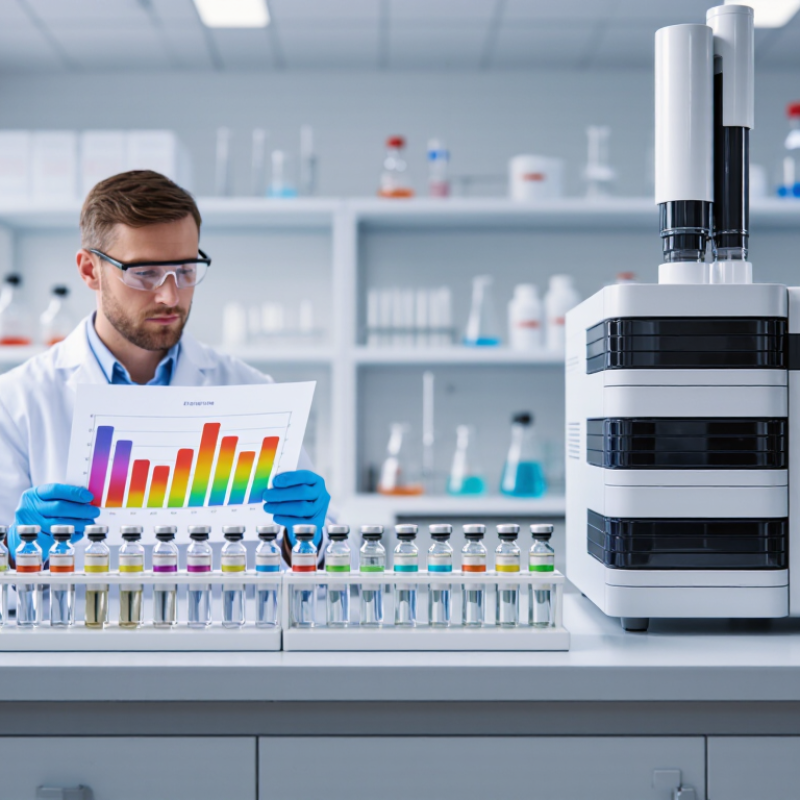
Peptide purity usually describes the proportion of detected material attributed to the main peptide, often measured by high-performance liquid chromatography (HPLC). A report might list 95% purity based on the relative areas of peaks in a chromatogram. That figure is useful, but it is not the same as 95% by weight. Different compounds can produce different detector responses, and water, salts, or residual solvents may not appear clearly in the result. Small details matter.
Purity matters because impurities can affect consistency, research results, and how a sample handles during storage or preparation. A high HPLC percentage alone does not confirm the peptide’s identity or sequence. Mass spectrometry can provide supporting identity data, while the test method and sample preparation help explain what the purity number actually represents. One easy mistake is treating a single percentage as a complete quality verdict. It is only one piece of evidence.
Tips: Ask for a batch-specific certificate of analysis, not a generic example. Check the test date, analytical method, reported result, and whether identity testing is included. Look for a chromatogram when available, and ask what the listed percentage measures. If the paperwork is vague, pause and ask questions. A neat report can still leave gaps.
How to Verify Peptide Purity Before You Buy
A certificate of analysis (CoA) is useful only when it matches the exact product lot being offered. Check that the lot number on the document matches the vial or listing, and look for a test date, sample description, and named analytical methods. Missing details are a reason to pause. A document without traceable lot information cannot confirm what is in a specific batch.
For identity, a CoA may report mass spectrometry results; for purity, it commonly reports high-performance liquid chromatography (HPLC). Check whether the report includes a chromatogram, the measured percentage, and enough method details to interpret the result. A high HPLC purity figure describes the detected profile under that method. It does not, by itself, confirm the amount of peptide in the vial, sterility, or suitability for any particular use. That distinction is easy to miss. If the testing laboratory and its relationship to the seller are unclear, ask for clarification or independent verification. I would not treat a polished certificate as proof on its own; even careful reports can leave practical questions unanswered. A little skepticism helps.
Use this guide to assess the evidence on a peptide Certificate of Analysis (CoA). The example values below are illustrative only—not results from a real batch. Acceptance criteria depend on the peptide, intended use, and applicable requirements.
| CoA item | What to check | Illustrative report entry | How to interpret it |
|---|---|---|---|
| Batch identification | Check that the batch or lot number on the CoA matches the product being offered. | Lot: P-24108 | A CoA without a lot-specific identifier may not establish that its results apply to the batch you will receive. |
| Sample and test dates | Look for a sample or test date and confirm that the document is relevant to the stated batch. | Test date: 2026-08-14 | Dates help assess record traceability; they do not, by themselves, prove product quality or current stability. |
| Purity by analytical HPLC | Check the method, chromatogram, integration, and whether the value is reported as area percent. | Main peak: 98.2% area | HPLC area percent estimates the proportion of detected chromatographic signal under the stated method. It is not automatically the peptide’s mass fraction or proof of identity. |
| Chromatogram and related peaks | Confirm that a chromatogram is available and that minor peaks, integration rules, and any excluded peaks are addressed. | Main peak: 98.2%; other integrated peaks: 1.8% | A purity number without supporting chromatographic data is harder to evaluate. Co-eluting or weakly detected impurities may not be represented fully. |
| Identity by mass spectrometry | Compare the reported observed mass with the expected mass, accounting for the stated molecular form and measurement type. | Expected average mass: 1,234.5 Da; observed: 1,234.6 Da | A close mass match supports identity, but mass alone may not distinguish sequence isomers or establish purity. |
| Sequence and peptide form | Verify the sequence, terminal modifications, cyclization, salt form, and any other specified structure against the product description. | Sequence and form: stated on specification | The same sequence can have different forms or modifications; these can change the expected mass and material properties. |
| Peptide content or net peptide | Check whether content is measured separately from chromatographic purity and whether the basis is clearly stated. | Net peptide content: 82% by weight | A lyophilized peptide may contain water, counterions, or residual salts. High HPLC area purity does not necessarily mean the powder is nearly 100% peptide by weight. |
| Water content | Look for a result and method, such as Karl Fischer titration, when water content matters to handling or dose calculations. | Water: 6.5% by weight | Water can contribute to the measured powder mass and may affect storage or calculations. The appropriate limit depends on the material and use. |
| Counterion or salt form | Check whether a counterion, such as acetate or trifluoroacetate, is specified and whether its level is measured when relevant. | Counterion: acetate; quantity not reported | Counterions can contribute to total powder mass. An unreported quantity may limit the accuracy of peptide-content or dose calculations. |
| Acceptance criteria and disposition | Look for pre-established specifications, pass/fail results, and an authorized review or release record. | Specification: purity ≥ 95.0%; reported result: 98.2%; disposition: passes purity criterion | A reported result is meaningful only in relation to a stated criterion and method. A purity pass does not establish sterility, safety, or suitability for a particular use. |
Practical check: request the complete, batch-specific CoA and supporting chromatogram when available. Confirm that the test methods, results, specifications, and material form match the item being evaluated.
A purity percentage is only meaningful when you know how it was measured.
High-performance liquid chromatography (HPLC) can estimate the relative area of detected peaks, but that figure is not automatically the peptide’s absolute content. Different impurities may respond differently to the detector, and some may be missed. A clean-looking trace can still mislead. Check whether the report names the column, detector, wavelength, sample preparation, and integration method, and whether the chromatogram is available for the specific lot.
Look for a separate identity check, commonly mass spectrometry, and ask whether the analytical method was validated for its intended use. The ICH Q2(R2) guideline, adopted in 2023, describes seven validation characteristics, including specificity, accuracy, precision, detection and quantitation limits, linearity, and range. These are useful questions, not a universal pass score. Numbers need context. Review replicate results, acceptance criteria, test date, and any stated uncertainty; ask how the lab handles peaks near its detection limit. A purity result without method details is hard to assess, even when the percentage looks precise.
References: ICH Q2(R2), Validation of Analytical Procedures (2023); USP General Chapter <621>, Chromatography.
A purity percentage alone cannot confirm what is in a vial. Check for a batch-specific analytical report that identifies the testing methods and sample date. Mass spectrometry can support molecular identity by comparing the measured mass with the expected mass. Chromatography, such as HPLC, can show the main peptide peak and other detectable components. Look for the chromatogram, not only a number. Confirm that the report’s batch identifier matches the product offered. A mismatch is a reason to pause.
Methods have limits. A clean chromatogram does not prove every possible contaminant is absent, and a mass result alone may not distinguish all structural variants. If the documentation is vague, request clarification or independent testing from a qualified laboratory. I would not treat polished paperwork as proof by itself. It is one useful piece of evidence, not the whole answer.
Before buying, ask for a certificate of analysis tied to the exact batch number on the product label. A generic certificate may describe a different lot. Check the report date, sample identifier, and testing laboratory, then compare them with the supplier’s listing. Small mismatches deserve a clear explanation.
Look for methods and results, not just a purity percentage. High-performance liquid chromatography can show a purity profile, while mass spectrometry can help confirm molecular identity. These tests answer different questions. A chromatogram should have readable labels and a stated method; an unexplained peak or missing test detail is worth asking about. Paperwork is not proof by itself. Ask whether the report covers the finished batch or only a reference sample, and whether an independent laboratory performed the analysis.
A transparent supplier should explain how batch records are maintained, how samples are handled, and what happens when a result falls outside specifications. Responses should be specific, not polished but vague. I would also check whether storage guidance and the product’s intended-use information are clearly stated. One imperfect document does not automatically settle the matter, but repeated gaps make verification difficult. Keep copies of the listing and batch documents for comparison when the shipment arrives.
