 Skip to content

Top 10 Powder Coating Spray Booth Manufacturers
A Powder Coating Spray Booth can shape finish quality, operator workflow, and production consistency. The right setup helps capture overspray and maintain controlled airflow around the workpiece. Small details matter: part dimensions, hanger clearance, filter access, and the distance between the booth and curing oven. A booth that looks suitable in a catalog may feel cramped once racks and operators are in place.
This Top 10 Powder Coating Spray Booth Manufacturers overview introduces suppliers serving different production needs, from compact workshops to higher-volume finishing lines. It considers practical factors such as booth design, airflow and filtration options, customization, installation support, and access to replacement parts. These points help buyers ask clearer questions before requesting a quotation. Specifications can vary by model and application, so confirm them directly with each manufacturer.
No shortlist is perfect. A strong choice for one facility may not suit another. Available floor space, coating volume, part geometry, and future expansion plans all influence the decision. It is also worth asking how filters are changed and how routine cleaning fits into a normal shift. These details are easy to overlook. The manufacturers featured here provide a starting point for comparison, not a substitute for a site assessment or a detailed technical review. Verify current product information, service coverage, and project requirements with the supplier before making a final selection.
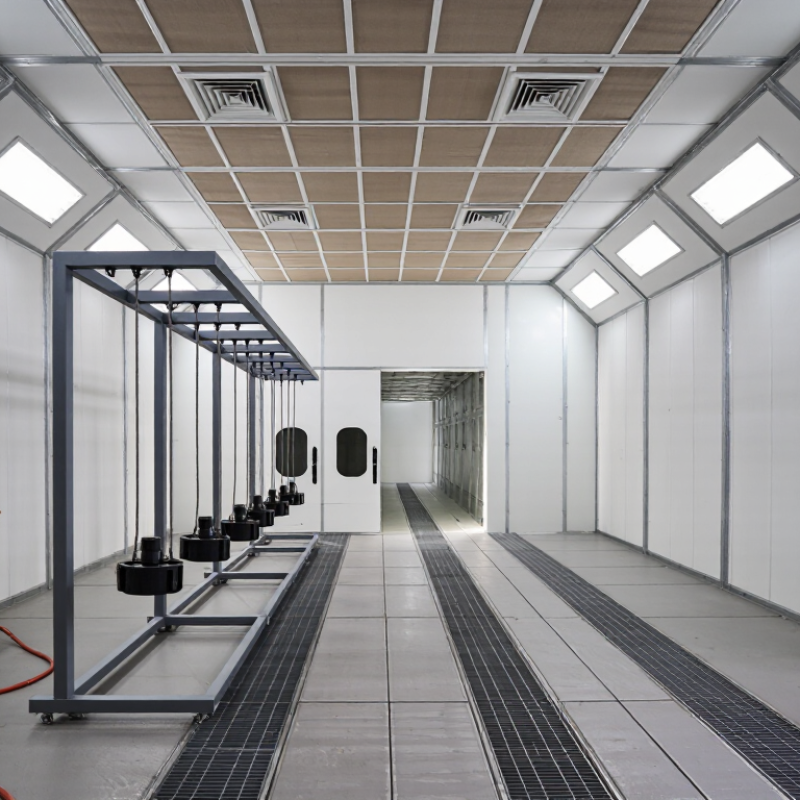
How Powder Coating Spray Booths Work
A powder coating spray booth does more than contain overspray. It manages airflow, captures airborne powder, and helps keep the coating area clean. A grounded metal part hangs from a rack inside the booth. The operator uses an electrostatic spray gun, which gives powder particles an electrical charge. The part’s grounding helps attract those particles to its surface. Air matters. Fans move air through the work zone toward filters, limiting powder drift and collecting excess material. The booth does not cure the coating; that happens later in a heated oven.
During spraying, airflow needs to be steady without disrupting the powder cloud. Too little movement can let powder collect on surfaces, while uneven flow may leave awkward areas thinly coated. Filters trap particles, and some systems collect powder for possible reuse when cleanliness and process controls allow it. Operators check filter condition, airflow, and the part’s electrical ground as routine setup tasks. A small gap in the rack contact can affect coating coverage. In practice, it is easy to focus on the spray gun and underestimate these details. The booth supports a repeatable process, but it cannot correct poor part preparation or careless technique.
Top 10 Powder Coating Spray Booth Manufacturers - How Powder Coating Spray Booths Work
A brand-neutral overview of common powder booth configurations and features. These are system types and design considerations, not a manufacturer ranking.
| Booth configuration or feature | How it works | Typical fit | Key consideration |
|---|---|---|---|
| Open-face manual booth | An exhaust system draws air from the open work face through the booth toward its powder collection filters. | Manual coating of small or medium parts in batch production. | Airflow must be designed to contain overspray without disrupting powder application. |
| Enclosed manual booth | The operator coats parts inside an enclosure while booth airflow carries airborne overspray to the collection system. | Batch work where greater separation from the surrounding workspace is useful. | Access, lighting, part handling, and cleaning should be considered in the layout. |
| Walk-in booth | A larger enclosed work area lets operators coat or handle oversized parts while exhaust airflow captures overspray. | Large components or parts that are difficult to move through a compact booth. | The booth and extraction system need to suit the part size, operator access, and required airflow pattern. |
| Batch booth | Parts are loaded, coated, and removed in groups rather than moving continuously through the booth. | Variable part sizes, short production runs, and job-shop work. | Loading and unloading time can affect throughput; hooks and fixtures need to support reliable grounding. |
| Conveyorized through-feed booth | Parts suspended from a conveyor pass through the application area while booth exhaust captures airborne powder. | Repeatable production with a regular flow of parts. | Conveyor speed, part spacing, and booth opening design influence line capacity and powder containment. |
| Cartridge-filter collection | Exhaust air passes through filter cartridges that capture overspray; some systems use periodic compressed-air pulses to clean filters. | Booths where powder is not routinely reclaimed for reuse, or where the system is designed for filter-based collection. | Filter condition and cleaning are important to maintaining the intended airflow. |
| Cyclone with final filtration | A cyclone separates a portion of overspray from the air stream; downstream filters capture remaining airborne powder. | Suitable reclaim systems and production involving compatible powder and color-change practices. | Recovered powder reuse depends on powder condition, contamination controls, and the coating process. |
| Non-reclaim collection system | Overspray is captured by the collection equipment and is generally not returned to the application process. | Frequent color changes, small production runs, or applications where reclaiming is not part of the process. | Powder disposal and filter replacement are operating considerations. |
| Quick color-change design | Accessible booth surfaces and collection components are arranged to make cleaning between powder colors more manageable. | Facilities that switch colors or coating jobs regularly. | Actual changeover time depends on booth geometry, equipment, cleaning procedure, and operator practice. |
| Automated application-compatible booth | The booth accommodates automatic spray equipment, such as reciprocators, while exhaust airflow contains overspray. | Repeat production requiring consistent gun movement or coordinated application. | Gun positioning, part presentation, grounding, and airflow should be considered together during system design. |
Note: Booth dimensions, airflow requirements, filtration, and recovery arrangements vary with the parts, powder, application equipment, production rate, and applicable safety requirements.