
Skip to contentChina’s garage-storage sector has grown from basic steel shelving into a competitive manufacturing field. This guide examines China Top 10 Garage Storage Rack Manufacturers and the standards separating reliable suppliers from attractive catalog listings.
Garage Storage Racks should be judged by more than price. Load capacity, steel thickness, weld quality, powder coating, assembly design, and dimensional accuracy matter in daily use. A rack holding toolboxes must remain stable when drawers open. A ceiling-height unit should not wobble under seasonal equipment. Warehouse testing, product documentation, and responsive after-sales support also deserve close attention.
Julie Morgenstern, a respected professional organizing expert, offers a useful principle: “Organizing is not about getting rid of everything you own… It’s about living the way you want to live.” That idea applies directly to garage planning. The best manufacturers create storage that matches real habits, not just showroom photographs. They offer adjustable shelves, practical depth, labeled components, and safer anchoring options. Some suppliers still provide vague load ratings. That weakness should not be ignored.
This overview compares ten leading Chinese manufacturers through product range, customization, production capability, quality controls, export experience, and buyer feedback. It also considers whether each company serves homeowners, contractors, distributors, or industrial users. Rankings can never be perfectly objective. Factory audits, changing materials costs, and inconsistent regional support may affect the final choice. Buyers should verify certificates, sample quality, packaging strength, and warranty terms before placing a large order. A strong supplier is not merely the cheapest option. It is the partner whose racks remain dependable after the garage becomes crowded, dusty, and genuinely busy.
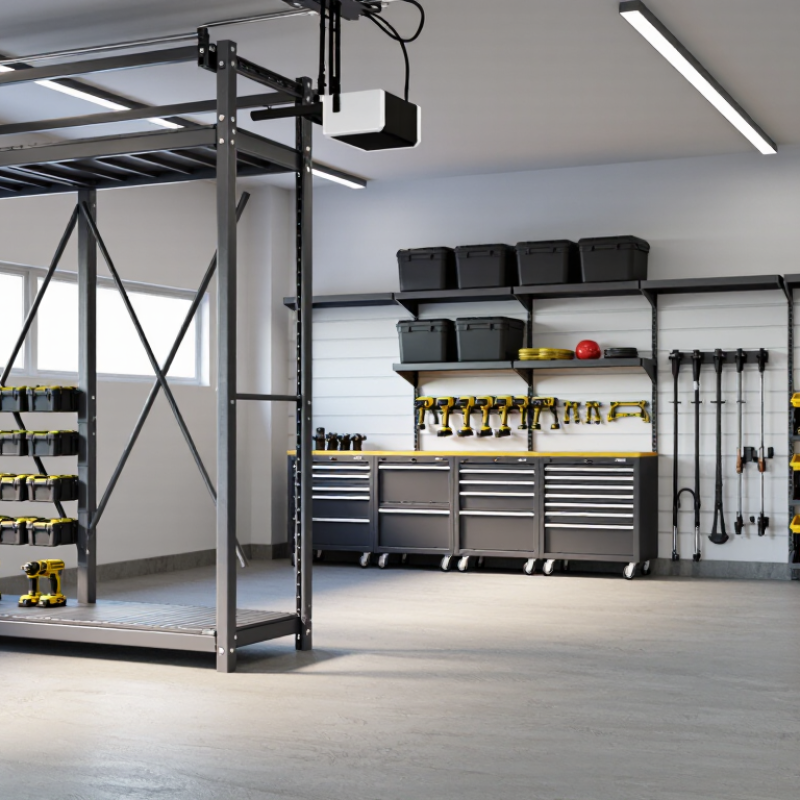
China’s garage storage rack market gained steady attention in 2024. Demand came from home renovation, small workshops, warehouses, and online furniture sales. Available market studies differ in scope, but many estimate annual growth near 5%–8% through the next several years. Trade activity remained strongest across North America, Europe, Southeast Asia, and the Middle East. Export buyers usually requested adjustable shelves, heavier load ratings, corrosion-resistant coatings, and flat-pack delivery.
A credible Top 10 manufacturer list should examine more than factory size. Production experience matters. So do welding quality, steel thickness, load testing, packaging, and shipment records. Some suppliers publish impressive capacity figures, yet provide limited test evidence. That deserves attention.
In 2024, buyers also preferred modular racks that fit narrow garages and changing storage needs. E-commerce demand pushed suppliers toward faster sampling, smaller order quantities, and clearer installation instructions. Freight costs still influenced final pricing, especially for bulky assembled units.
Tips: Ask for recent load-test reports, material specifications, carton photos, and sample approval before ordering. Compare usable shelf space, not only advertised dimensions. Check whether the stated CAGR reflects garage racks alone or the wider storage furniture market. A cheap frame can become expensive after damaged corners, missing hardware, or difficult assembly. Measure the garage first. Then review production consistency across several batches.
China Top 10 Garage Storage Rack Manufacturers?
How to Rank the Top 10 Manufacturers by Capacity, Quality, and Export Data
A credible ranking should begin with verifiable production capacity, not online visibility. Check factory size, forming lines, welding stations, warehouse space, and monthly output. A manufacturer producing 20,000 rack units monthly may handle large orders better than a smaller workshop. However, capacity figures require independent confirmation. Supplier declarations can be incomplete.
Quality needs measurable evidence. Review steel thickness, load-bearing test reports, coating adhesion, weld consistency, and packaging strength. Inspect samples from different production batches, not only showroom units. Ask for inspection records and corrective-action reports. Small defects matter. Bent beams, uneven holes, or weak cartons can create costly problems during installation.
Export performance adds another practical filter. Compare shipment frequency, destination coverage, repeat orders, and customs records over several years. One large shipment does not prove stable international service. Reliable manufacturers usually maintain consistent export activity and clear documentation. Evaluate lead times, replacement-part support, and communication during complaints. Ranking only by export volume can mislead, because low-price products may sell widely while generating more service issues. A transparent scorecard might assign equal weight to capacity, quality, and export reliability. The method is useful, but not perfect. Data may be delayed, unaudited, or influenced by seasonal demand. Human verification still matters.
Benchmark ranking by production capacity, quality capability, and export readiness
The ranking uses a normalized 100-point screening index: production capacity accounts for 40%, quality capability for 30%, and export readiness for 30%. Manufacturer identities are intentionally anonymized. Scores should be validated against current factory audits, certifications, production records, and customs data before procurement decisions.
China’s top ten garage storage rack manufacturers differ sharply in load ratings and product coverage. A comparison of published catalogs shows rated shelf capacities from 100 to 800 kilograms, while heavy-duty pallet systems commonly reach 2,000 to 5,000 kilograms per level. Seven manufacturers offer boltless shelving, pallet racks, and workbenches. Only four provide cantilever racks or mezzanine systems. This matters because a compact garage needs different engineering from a warehouse aisle.
Grand View Research estimates the global warehouse racking market will continue growing through 2030, supported by e-commerce and industrial storage demand. However, market growth does not prove product reliability. The Rack Manufacturers Institute’s ANSI MH16.1 standard stresses structural design, frame strength, and load documentation. Buyers should request tested working loads, beam deflection limits, steel thickness, and corrosion protection. Catalog numbers alone are not enough.
In practical comparisons, the strongest product lines usually include adjustable shelving, pallet racks, tire storage, drawer cabinets, and modular workstations. Some Chinese suppliers list impressive capacities but provide limited information about testing conditions. That is a weakness. Real performance depends on floor flatness, anchor installation, beam spacing, and evenly distributed loads. EN 15635 guidance also recommends regular inspections, especially after impact damage. A rack that looks solid may still fail when overloaded or poorly assembled.
Selecting China’s top 10 garage storage rack manufacturers requires more than comparing websites or showroom photos. A factory audit should verify ISO 9001 certification, including its issuing body, scope, and validity dates. The certificate must match the actual production site. Paperwork alone is not enough.
Production scale needs physical evidence. Auditors should inspect welding stations, powder-coating lines, assembly areas, and finished-goods storage. Count active workers and observe shift patterns. Ask for recent monthly output records, not only claimed capacity. A clean warehouse with labeled pallets suggests control, but it does not prove consistent quality.
Lead times should be checked against purchase orders from the previous six months. Compare promised dates with dispatch records and investigate delays. MOQ evidence also matters. Request quotations for standard racks, customized sizes, and mixed-container orders. Some factories advertise flexible MOQs but quietly impose high quantities on custom finishes. That detail can change the real supplier ranking.
Small details reveal experience. Measure frame thickness with a calibrated gauge. Check weld penetration, coating adhesion, carton strength, and hardware counts. Photograph samples during the audit. Factory conditions can change after one visit. That is a limitation worth admitting. ISO 9001 supports process discipline, but it cannot guarantee every shipment. Buyers should repeat inspections, confirm capacity seasonally, and keep written evidence for each manufacturer’s score.
| Anonymous Factory Profile | Primary Product Scope | ISO 9001 Evidence Status | Typical Production Scale | Estimated Monthly Capacity | Standard Lead Time | Custom Lead Time | Indicative MOQ | Production & Quality Evidence to Request | Audit Risk Level |
|---|---|---|---|---|---|---|---|---|---|
| Factory Profile 01 | Heavy-duty steel garage shelving, boltless racks, utility storage units | Certificate reported Verify scope, expiry date, and issuing body | Dedicated forming, punching, welding, powder-coating, and assembly areas | Approx. 8,000–12,000 rack units | 25–35 days | 35–50 days | 100–300 units | ISO certificate; process flow; coating thickness records; load-test reports; recent inspection records | Medium |
| Factory Profile 02 | Adjustable garage shelving, metal cabinets, pegboard systems | Claimed Certificate copy and validity not independently confirmed | Medium-scale factory with outsourced surface treatment reported | Approx. 4,000–7,000 rack units | 30–40 days | 40–60 days | 200–500 units | Subcontractor list; coating supplier records; incoming-material inspection; carton drop-test evidence | Medium–High |
| Factory Profile 03 | Garage workbenches, storage cabinets, modular wall-mounted racks | Certificate reported Confirm whether the certificate covers manufacturing activities | Integrated sheet-metal fabrication and automated powder coating | Approx. 6,000–10,000 rack units | 28–38 days | 40–55 days | 100–300 units | Calibration certificates; weld inspection; salt-spray results; packaging specifications; corrective-action log | Medium |
| Factory Profile 04 | Light-duty boltless racks, plastic-and-steel garage organizers | Not publicly verified | Small-to-medium production site with mixed manual assembly | Approx. 2,000–5,000 rack units | 35–45 days | 50–70 days | 300–800 units | Factory registration; machine list; daily output records; material certificates; third-party pre-shipment inspection | High |
| Factory Profile 05 | Commercial garage racks, pallet-style storage frames, heavy steel shelving | Certificate reported Check site address against certificate address | Large-scale facility with separate raw-material and finished-goods warehouses | Approx. 10,000–18,000 rack units | 25–35 days | 35–50 days | 100–300 units | Production planning records; steel coil traceability; load-deflection testing; warehouse inventory evidence | Low–Medium |
| Factory Profile 06 | Garage corner racks, folding shelves, compact storage systems | Claimed Scope and surveillance-audit status require confirmation | Flexible production lines suited to small and medium batches | Approx. 3,000–6,000 rack units | 30–45 days | 45–65 days | 100–300 units | Change-control procedure; sample approval records; assembly instructions; fastener torque records | Medium–High |
| Factory Profile 07 | Industrial garage shelving, tire racks, long-span storage racks | Certificate reported Verify current validity and product-category relevance | Heavy-gauge steel line with robotic welding reported | Approx. 7,000–14,000 rack units | 30–40 days | 40–60 days | 200–500 units | Welding procedure qualification; operator records; dimensional inspection; structural-load test methodology | Low–Medium |
| Factory Profile 08 | Retail-ready garage shelving kits, DIY racks, e-commerce packaging | Not publicly verified | Assembly-focused operation with packaging and labeling capability | Approx. 4,000–8,000 rack units | 35–50 days | 50–75 days | 500–1,000 units | Packaging line audit; barcode controls; carton compression test; fulfillment accuracy; product traceability | High |
| Factory Profile 09 | Premium powder-coated shelving, modular cabinets, wall storage panels | Certificate reported Confirm certificate number through the issuing organization | Mid-to-large facility with in-house design and tooling support | Approx. 6,000–11,000 rack units | 28–40 days | 40–55 days | 100–300 units | Design-change records; tooling maintenance; color-master approval; coating adhesion and impact tests | Medium |
| Factory Profile 10 | OEM garage storage systems, branded private-label racks, mixed metal organizers | Claimed Independent document verification required | Multi-line OEM facility with mixed in-house and subcontracted processes | Approx. 5,000–10,000 rack units | 30–45 days | 45–70 days | 200–500 units | Subcontractor audit; capacity-loading plan; bill-of-material control; export documentation; reference orders | Medium–High |
China’s top ten garage storage rack manufacturers should be compared through safety evidence, not catalog photos. EN 15512 defines structural design principles, including load capacity, frame stability, and connection behavior. EN 15635 governs operational safety, inspections, damage reporting, and corrective action. In China, GB/T 33454-2016 provides practical guidance for storage rack use, while GB/T 28576-2012 supports steel rack design.
A reliable manufacturer should provide signed calculations, material certificates, weld inspection records, and load plaques. Ask whether testing reflects your actual garage floor, beam spacing, pallet weight, and seismic conditions. MHI’s 2024 Annual Industry Report found that 55% of supply-chain organizations planned to increase technology investment. That pressure can improve traceability, but digital records do not replace physical inspections. A rack may look excellent and still fail after an overloaded beam or an unnoticed forklift impact. This is where supplier claims need careful checking.
Tips: Request an EN 15512 design basis and an EN 15635 inspection procedure. Confirm that Chinese documents match the delivered configuration. Mark damaged uprights immediately. Keep aisle clear. Photograph every defect. One weakness remains common: buyers compare prices before verifying engineering scope. That habit deserves reconsideration.
