
Skip to contentChoosing a China-based Assembly Machine manufacturer requires more than comparing prices, brochures, or polished factory videos. The right supplier must prove stable cycle times, repeatable positioning, safe operation, and responsive after-sales support. A machine may look impressive under showroom lighting, yet struggle with dust, vibration, or changing product tolerances on a real production line.
Industry data shows why this decision matters. The International Federation of Robotics reported 541,302 industrial robots installed worldwide in 2023. It also recorded more than four million robots operating globally. These figures reflect a wider movement toward automated assembly, inspection, and material handling. Deloitte’s 2023 Smart Manufacturing survey found that 86% of manufacturers expect smart manufacturing to become a major competitiveness driver within five years. The market is moving quickly. Supplier evaluation cannot remain informal.
Joseph Engelberger, widely recognized as the father of industrial robotics, said, “I can’t define a robot, but I know one when I see one.” His remark offers a useful warning. Buyers should define measurable requirements before judging equipment. Ask for documented accuracy, output testing, maintenance records, software compatibility, and customer references. Request a sample run using your actual components. Watch the machine operate for several hours, not several minutes.
This guide examines how to assess China’s top Assembly Machine manufacturers through engineering capability, customization experience, quality controls, certifications, and lifecycle service. A low purchase price can still become expensive. My own view is less perfect: no ranking can replace a factory audit and a realistic acceptance test.
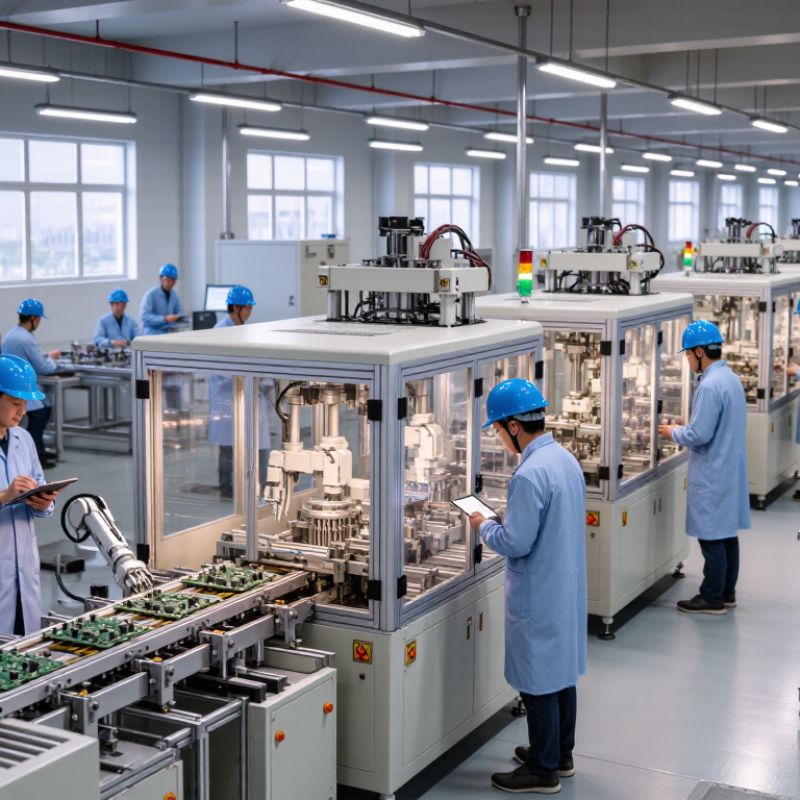
What Are Assembly Machines and Where Are They Used?
Assembly machines combine parts into finished products with controlled, repeatable movements. They may feed components, position them, fasten screws, apply adhesives, inspect surfaces, and test performance. A typical line can include vibration feeders, robotic arms, vision cameras, torque tools, and traceability software.
They are widely used in electronics, automotive components, appliances, medical equipment, and precision hardware. For example, one station may place a small connector, tighten two screws, and check alignment within seconds. The International Federation of Robotics reported 541,302 industrial robots were installed worldwide in 2023. This figure shows the growing role of automated assembly in modern factories. The World Robotics 2024 report also recorded more than 4.2 million industrial robots operating globally.
Speed is not everything.
When evaluating assembly machine manufacturers in China, buyers should examine cycle time, repeatability, changeover design, operator safety, spare-part access, and service response. Deloitte’s 2024 Smart Manufacturing and Operations Survey found that many manufacturers view smart production as a major competitiveness factor, but integration remains difficult. This is often overlooked. A machine may perform well during a demonstration but struggle with dusty parts, irregular feeding, or frequent product changes. Buyers should request sample testing, acceptance criteria, maintenance records, and realistic production data. No machine is perfect, and early specifications are sometimes incomplete. That weakness deserves honest review before purchase.
Chinese assembly machine manufacturers offer far more than one standard platform. Common options include screwdriving machines, press-fit systems, dispensing equipment, riveting lines, ultrasonic welding cells, and automated testing stations. For small electronic parts, SCARA robots often provide fast horizontal movement. Delta robots suit lightweight picking and sorting. Six-axis robots handle changing angles, while Cartesian systems remain practical for straight, repeatable movements.
The scale is significant. The International Federation of Robotics reported 276,288 industrial robot installations in China during 2023, representing about 51% of global installations. This supports a broad local supply chain for robotic assembly, machine vision, feeding systems, and traceability software. Other industry reports, including analyses from MarketsandMarkets, continue to identify electronics, automotive components, and medical devices as major automation demand areas. A buyer should inspect cycle time, feeder stability, changeover steps, spare-part access, and actual sample testing. Ask to see a full run with your materials. A machine may look impressive but struggle with oily surfaces or tiny tolerances. That detail is often missed. “High speed” also needs context: speed without stable feeding creates expensive stoppages. Consider semi-automatic equipment when product volume remains uncertain. Fully automatic lines can be excellent, but they are not always the wiser investment.
| Machine Type | Primary Function | Typical Applications | Typical Automation Level | Typical Output Range* | Main Advantages | Key Selection Factors |
|---|---|---|---|---|---|---|
| Manual Assembly Workstation | Supports operator-led assembly, inspection, and fastening operations. | Low-volume products, prototypes, customized components, and frequent product changes. | Manual or operator-assisted | Approximately 5–30 units/hour, depending on product complexity. | Low initial investment, high flexibility, and simple changeover. | Labor availability, ergonomic design, fixture accuracy, and required production volume. |
| Semi-Automatic Assembly Machine | Automates repetitive steps while an operator loads parts or starts the cycle. | Electrical components, small appliances, hardware, and mechanical subassemblies. | Semi-automatic | Approximately 20–120 units/hour. | Improves consistency while retaining flexibility for mixed production. | Operator loading time, cycle time, fixture design, safety guarding, and changeover method. |
| Automatic Rotary Indexing Machine | Moves parts through multiple assembly stations on an indexed rotary table. | High-volume small components, valves, connectors, switches, and consumer products. | Fully automatic or integrated automatic line | Approximately 20–180 cycles/minute, depending on process and part handling. | Compact layout, repeatable positioning, and simultaneous multi-station processing. | Number of stations, indexing accuracy, tooling life, feeding stability, and maintenance access. |
| Automatic Linear Transfer Machine | Transfers workpieces through sequential assembly, inspection, and testing stations. | Automotive components, battery modules, power tools, and larger mechanical assemblies. | Fully automatic | Approximately 10–100 cycles/minute, based on product size and process complexity. | Suitable for long process sequences and integration with traceability systems. | Line length, takt time, workpiece orientation, buffer capacity, and future expansion. |
| Pick-and-Place Assembly System | Transfers, aligns, and places components using pneumatic, servo, or robotic motion. | Caps, housings, connectors, electronic parts, medical disposables, and small hardware. | Semi-automatic to fully automatic | Approximately 20–200 picks/minute, depending on payload, travel distance, and accuracy. | Fast component placement and easy integration with feeders and vision inspection. | Payload, reach, positioning accuracy, gripper design, part presentation, and vision requirements. |
| Automatic Screwdriving Machine | Feeds, positions, and tightens screws with controlled torque and depth. | Electronics, appliances, furniture hardware, automotive parts, and plastic housings. | Semi-automatic to fully automatic | Approximately 10–60 fastening points/minute. | Consistent torque control, reduced operator fatigue, and fastening traceability. | Screw size, torque range, fastening angle, cross-thread prevention, and data-recording needs. |
| Press-Fit and Riveting Machine | Joins components through controlled pressing, staking, crimping, or riveting. | Bearings, shafts, terminals, metal brackets, bushings, and electrical assemblies. | Manual, semi-automatic, or fully automatic | Approximately 10–80 joining cycles/minute. | Controlled joining force, repeatable quality, and suitability for interference-fit parts. | Required force, stroke, displacement monitoring, tooling alignment, and part deformation limits. |
| Dispensing and Adhesive Assembly Machine | Applies adhesives, sealants, lubricants, or conformal materials in controlled patterns. | Electronics, sensors, LED products, automotive modules, and sealed housings. | Semi-automatic to fully automatic | Approximately 10–120 parts/hour, depending on path length and curing time. | Accurate material volume, repeatable bead paths, and reduced material waste. | Material viscosity, curing method, dispensing accuracy, temperature control, and cleaning requirements. |
| Robotic Assembly Cell | Uses industrial or collaborative robots for handling, assembly, inspection, or machine tending. | Automotive, electronics, logistics equipment, appliances, and variable product lines. | Highly automated | Approximately 10–120 cycles/hour, depending on robot motion and assembly steps. | Flexible automation, reprogrammability, and integration with vision and testing systems. | Robot payload, reach, safety assessment, end-of-arm tooling, cycle time, and programming support. |
| Assembly and Inspection Integrated Line | Combines assembly with machine vision, electrical testing, leak testing, or dimensional verification. | Medical devices, automotive safety parts, electrical products, and regulated components. | Fully automatic | Approximately 10–100 units/minute, depending on inspection and test duration. | Improves process control, defect detection, traceability, and production reporting. | Inspection accuracy, false-rejection rate, data storage, traceability format, and validation requirements. |
*Output figures are indicative industry ranges. Actual performance depends on product geometry, component feeding, assembly sequence, quality requirements, operator involvement, and machine configuration.
Evaluating China’s leading assembly machine manufacturers requires more than comparing online catalogs. Start with the machine’s actual application, including product size, materials, cycle time, and required tolerance. Ask for a live production trial using your components, not substitute samples. Watch the feeder, gripper, sensor, and inspection station during repeated cycles. Small jams often reveal more than polished presentations.
Request measurable evidence. Review cycle-time records, first-pass yield, changeover duration, and maintenance logs from similar projects. A capable manufacturer should explain how these figures were measured. Check engineering depth through drawings, pneumatic diagrams, software architecture, and spare-parts lists. Confirm whether the electrical system, guarding, emergency stops, and documentation match your destination requirements. Factory acceptance testing should include agreed sample quantities and failure criteria.
Do not judge reliability from factory size alone. I have seen impressive workshops overlook weak after-sales planning. Ask who will support installation, how quickly remote engineers respond, and whether technicians can troubleshoot in your language. Contact recent customers and ask about delivery accuracy, modifications, and downtime after commissioning. Be careful with unusually low quotations; missing tooling, validation, or training may appear later. I would also leave room for uncertainty. No supplier can promise zero faults. The stronger partner explains risks early, records corrective actions, and improves the design after testing. That honesty is often more valuable than a perfect sales demonstration.
When comparing top assembly machine manufacturers in China, buyers should examine technical evidence, not polished brochures. Ask for cycle-time data from a product similar to yours. A claimed rate may change with part size, operator skill, or inspection requirements. Request a live test using your components. Small variations matter.
Check the machine’s positioning accuracy, torque control, sensor repeatability, and software access. Confirm whether the PLC records alarms, process values, and maintenance history. A clear electrical layout helps technicians diagnose faults faster.
Review changeover time with actual tooling, not an estimate. Also inspect guarding, emergency stops, noise levels, and documentation for compliance with your operating region.
Service quality often decides whether production remains stable after installation. Ask how quickly engineers respond across time zones. Clarify remote support, on-site training, spare-part availability, and warranty exclusions. A dependable supplier should provide acceptance criteria before shipment and support factory acceptance testing.
I once focused too heavily on output speed. The machine later needed frequent manual adjustments. That mistake showed me that maintainability deserves equal attention.
Buyers should also request references from facilities with similar materials and production volumes. One overlooked issue remains important: operators must understand the interface without constant assistance.
Choosing among China’s top assembly machine manufacturers requires more than comparing prices. The right manufacturer must understand your product, production volume, and quality targets. Ask for documented experience with similar assemblies. Request videos, drawings, and sample test records. A polished sales presentation is not enough.
Check how the manufacturer studies your project. Reliable teams review component tolerances, cycle time, operator safety, and future maintenance. They should explain the machine structure clearly, including sensors, fixtures, control systems, and changeover procedures. Ask for a factory acceptance test with measurable standards. For example, define output per hour, defect limits, noise levels, and testing duration. Vague promises create expensive disputes later.
Communication reveals practical reliability. Can the engineering team answer technical questions directly? Do they provide clear drawings and revision histories? Check references from comparable projects, not unrelated industries. I once saw a low quotation appear attractive, but missing spare parts and installation support increased the real cost. That mistake still matters. A strong supplier also discusses training, remote troubleshooting, replacement parts, and delivery risks before signing. Request a detailed timeline with design approval, assembly, testing, shipment, and installation milestones. Allow room for revisions. Real projects rarely remain unchanged.
Suggested evaluation weights for comparing manufacturers against your project requirements
Start with process capability and throughput, then verify flexibility, quality traceability, after-sales support, and safety compliance. These weighting values are a practical project-evaluation framework and should be adjusted according to product complexity, production volume, regulatory requirements, and available budget.
