
Skip to contentChoosing the best Bed Fan supplier in China takes more than comparing prices or browsing polished product photos. Buyers should examine airflow performance, noise levels, power use, materials, and the quality of the controls. A useful supplier can explain how its fan directs cool air beneath the sheets, where a standard bedside fan may offer little relief. Ask for clear specifications and, when possible, a working sample. Test it in a real bedroom. Details matter.
This guide considers manufacturers and suppliers through practical questions: Do they communicate clearly? Can they provide consistent product information, quality-control details, and warranty terms? Are sample orders and production timelines explained without vague promises? Buyers should also request relevant product documentation and verify that it matches their target market’s requirements. A responsive sales contact is helpful, but it does not prove reliable manufacturing. Check the evidence.
There is no single supplier that suits every buyer. A hotel group may value durable construction and repeatable orders, while a small retailer may need flexible quantities and responsive support. Price still matters, of course, though the cheapest quotation can hide compromises in motors, packaging, or after-sales service. That is easy to overlook. This comparison aims to help readers assess Chinese Bed Fan suppliers with specific, verifiable criteria rather than broad claims. Some details may remain uncertain until a sample is tested; acknowledging that limitation is better than treating a catalogue as proof.
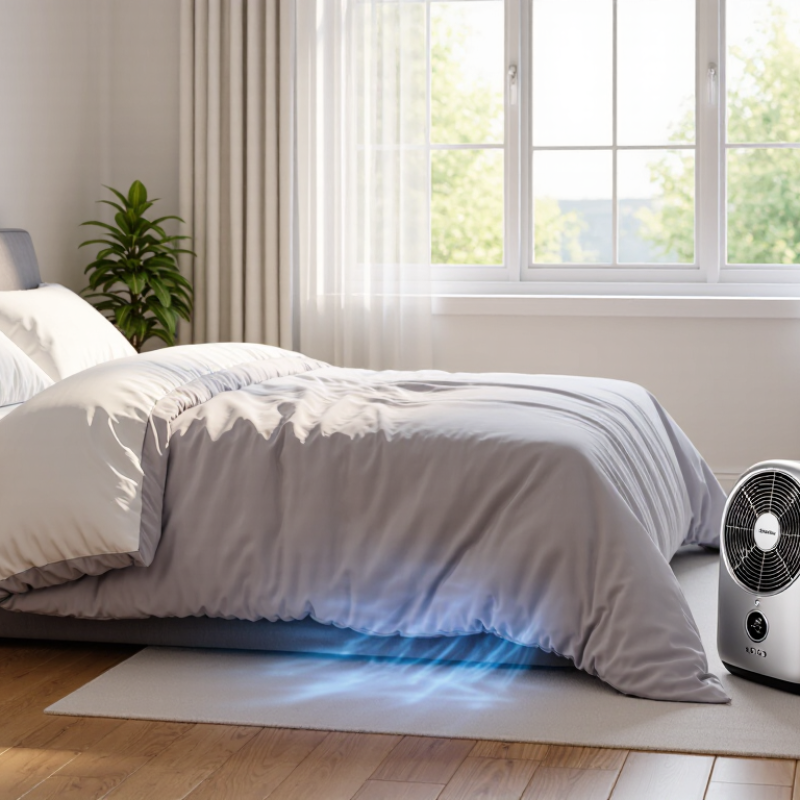
A bed fan is a small airflow device designed to move room air beneath the sheets. It cools the sleeper’s bedding area rather than lowering the temperature of the whole room. That distinction matters in warm bedrooms, or when one person feels hot while a partner does not. The CDC’s 2014 Behavioral Risk Factor Surveillance System analysis found that 35.2% of U.S. adults usually slept fewer than seven hours per night. The CDC recommends at least seven hours for adults, but a fan cannot replace adequate sleep time. It may simply make the bed feel less stuffy.
Airflow is usually directed through a low-profile unit near the foot of the bed, then along the space between mattress and top sheet. A gentle setting can reduce trapped warmth without blowing directly across the face. Small detail. It matters. Keep the air inlet clear, and check that the hose or outlet is not folded under bedding. Results depend on room temperature, humidity, sheet material, and personal sensitivity; there is no single setting that suits everyone. ASHRAE’s Standard 55 also treats thermal comfort as dependent on factors such as air speed, humidity, clothing, and activity. That is a useful reminder: bed fans support comfort, but they do not guarantee better sleep. A little trial and adjustment is often needed.
When evaluating bed fan suppliers in China, verify engineering capability before comparing quotes. Ask for airflow data at several speed settings, measured at a stated distance, and request noise readings in decibels. A sample should run beside a bed for several hours; check motor heat, vibration, hose stability, and whether airflow reaches the intended area. A polished brochure is not proof. Test it.
Energy performance also deserves attention. The International Energy Agency’s 2018 Future of Cooling report estimated that cooling accounted for about 10% of global electricity consumption. This figure covers cooling broadly, not bed fans specifically, but it highlights why buyers should compare power input with measured airflow. Request the test method, raw results, and details of the meter used. If the supplier cannot explain how readings were taken, the numbers are hard to trust.
Review production controls, too. Ask how incoming motors and plastic parts are inspected, how defects are recorded, and whether each shipment has traceable batch records. Check that sample specifications match the production order, including cable length, speed controls, and included accessories. Request relevant test documents and confirm their scope and issuing laboratory; a certificate alone may not cover the finished product. Small gaps matter. I would still inspect a pre-shipment unit, because paperwork can miss a loose connector or an uneven airflow pattern.
Chinese bed fan suppliers generally fall into three groups: export-focused OEM factories, established small-appliance makers, and specialist ventilation workshops. Their strengths differ. OEM factories often offer custom housings, control panels, and packaging for overseas orders. Appliance makers may bring steadier motor sourcing and more developed quality checks. Specialist workshops can be more flexible with duct shapes and compact designs.
Look for clear airflow specifications, not vague claims about “strong wind.” A useful supplier should explain fan speed, noise levels, hose length, and how air reaches the bed. Some models use a flat, low-profile unit beneath the mattress, with a flexible outlet aimed toward the sleeper. Helpful details include a reachable remote, a simple timer, and a grille that can be cleaned without tools. Small things matter.
Ask for test reports and a working sample before discussing large orders. Listen for motor hum in a quiet room, and check whether airflow remains even along the hose. A polished product photo proves little. Supplier experience with similar products is valuable, but it does not replace inspection. I would also compare replacement-part availability; this point is easy to overlook, and supplier answers can be less specific than expected.
Comparing bed fan suppliers in China starts with the sample, not the catalog. Ask for a unit built with the same motor, grille, and controller planned for production. Run it beside a bed at low and high settings, noting airflow, noise, vibration, and heat after several hours. Small details matter. Check cable strain relief, seam finish, and whether the base shifts on a smooth floor.
Quality claims need evidence you can inspect. Request component specifications, inspection records, and details on how incoming parts and finished units are checked. Ask how defects are handled and whether replacement parts remain available. If possible, arrange a pre-shipment inspection with agreed criteria, such as carton checks and speed-control tests. A polished sample is not proof. Keep that in mind.
Compare quotes line by line: unit price, tooling, packaging, sample fees, minimum order, lead time, and shipping terms. The lowest offer may use a different motor or controller. For customization, confirm airflow levels, timer options, cord length, color, labeling, and packaging in a written specification. Ask which changes affect cost or delivery. I would leave time for a revised sample; drawings rarely catch every fit issue.
Compare suppliers by checking product quality, pricing, customization, production capacity, and communication—not by relying on price alone.
How to use this chart: These percentages are a suggested buyer evaluation model, not verified scores for specific suppliers. Request product samples, written quotations, customization details, and production timelines, then score each supplier against the same criteria.
A reliable bed fan supplier is verified through evidence, not polished product photos. Request a company profile, factory address, and current product specifications. Compare the company name on the quotation, invoice, and sample label. Small mismatches deserve a clear explanation. Ask who manages motor selection, assembly, and final inspection. A trading company may still be suitable, but its responsibilities should be clear.
Request a working sample and test it beside a bed. Check airflow at pillow height, noise on different settings, cable reach, control response, and stability near the mattress edge. Record the model number and rated voltage, then confirm they match the quotation. Ask for test records, inspection criteria, and written warranty terms. A supplier’s answers matter, but consistency matters more. For a large order, request another sample from regular production. It may feel awkward. Ask anyway.
Tips: Keep a short checklist and save supplier replies in writing. Confirm lead time, packaging dimensions, spare-part availability, and what happens if a sample fails inspection. Replace vague claims like “quiet” with measurable noise levels and test conditions. If a claim cannot be verified, mark it as unresolved rather than assuming it is true. Even careful buyers miss details.
